Neoprene

Product introduction
A multi-purpose rubber with proven performance in more than a thousand applications for half a century.
At the beginning of its invention, it was developed into an oil-resistant artificial rubber to replace raw rubber. Because of this, NEOPRENE is still widely used today.
In any case , NEOPRENE's unique combination of physical properties has been used in more than a thousand applications throughout the industry. Among them, it is Well-known
properties are as follows:
* Extreme heat resistance
- NEOPRENE has a practical high temperature, with a continuous use range of 80 degrees to 95 degrees. Within this range, it shows
good physical properties. If used intermittently, the special formula can reach 120 degrees. , exceeding this limit will not cause
NEOPRENE to soften or melt, but may cause hardening or loss of elasticity.
Cold - When used at minus 20 degrees to minus 25 degrees, the properties will only change slightly. Below this temperature, it will gradually harden before the embrittlement temperature
(minus 40 degrees??). The special formula allows the use temperature to be as low as minus 55 degrees. ??.
*Remarkable resistance to wax, fat, oil, lubricating oil and various petroleum products.
*Good resistance to alkali, dilute mineral acid and inorganic salt solutions.
*With proper formula, it has good ozone and weather performance.
* Can obviously be immersed in water or buried under soil for a long time.
*Bending resistance, significant torsion resistance, and good resistance to compression distortion.
Products manufactured using NEOPRENE include: outer coverings of wires and cables, industrial gaskets, hoses, belts, tapes
, caulking agents for construction projects, structural bearings, foam products, various adhesives, coatings, industrial/ Agricultural/automotive
, extruded/compression molded products, as well as a variety of consumer products for the shoe industry, paper industry, packaging industry, construction industry, etc.
NEOPRENE Specifications
|
TYPICAL CONTACT ADHESIVE FORMULATIONTypical
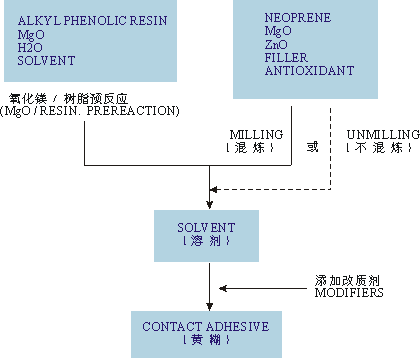
THE MANUFACTURING PROCEDURE OF CONTACT ADHESIVE
|
|||||||||||||||||