

Chlorosulfonated polyethylene rubber

Product introduction
Why should you use Hypalon®
DuPont Hypalon® synthetic rubber has a variety of excellent properties and has been widely used in the rubber industry. In some special properties
and application ranges, it is even more outstanding and extensive than clopine rubber Neoprene. Hypalon®'s The excellent characteristics can be summarized into
the following nine points:
It can produce brightly colored products that do not fade and prevent microbial erosion.
Even non-black products have excellent weather resistance and antioxidant properties.
The heat resistance can reach 125~135℃. If it is synthesized with special compounds, the heat resistance can reach 140~150℃.
The low-temperature elasticity can reach -18~-23℃. If synthesized with special compounds, the low-temperature resistance can reach -40℃.
Resistant to many oxidants and aggressive chemicals.
The oil resistance, grease resistance and solvent resistance are the same as those of clopine rubber and closer to medium nitrile rubber.
Good electrical insulation. l Wear-resistant and abrasion-resistant properties. l Not easy to burn.
In the above characteristics, DuPont Hypalon® is far better than SBR and polyisoprene. Although the latter two
can improve some of their characteristics by adding some additives (such as antioxidants, anti-ozonants, flame retardants), but Generally speaking, they are far
worse than Hypalon®. Similarly, nitrile rubber is only better than Hypalon® in terms of oil resistance and solvent resistance, but is much worse
in terms of
heat resistance , weather resistance and oxidation resistance, especially in terms of non-flammable properties, SBR, plysioprene and nitrile
None are as good as Hypalon®. In most cases, the three cannot replace Hypalon® in some high-tech industrial applications.
This situation is more obvious in the automotive industry, military industry and mechanical applications.
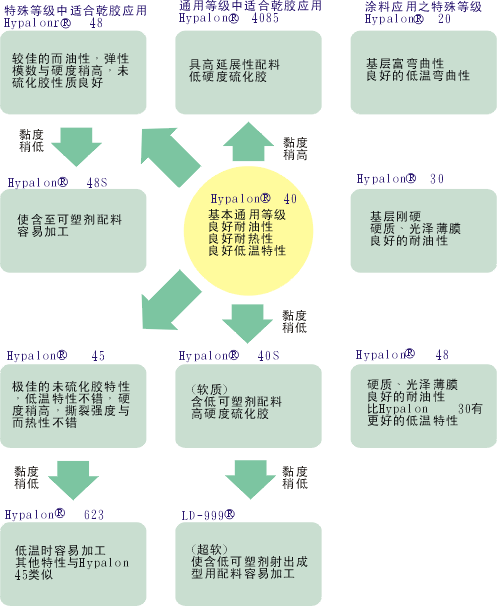
Grade selection
Product application
The following are the areas where DuPont Hypalon® is often used:
1. Coatings
Hypalon® coatings have both hard and soft properties and can be used in a variety of applications. They are resistant to gas, moisture
penetration , weather resistance, chemicals, greases, and solvents, and maintain bright colors. For important applications Hypalon® is suitable for heat-reflecting products such as inflatable
textiles , membranes, waterproof cloths, gloves, clothing, light-colored roof coatings, etc. In addition,
coatings for chemical storage tanks or equipment, waterproofing membranes for pools or drainage basins, etc. Use often.
2. A very special application of Hypalon®, a roof waterproofing and thermal insulation tape
, is a single-layer roof building material system. It can be made into a white finished product and laid on the roof. It has
excellent waterproof, thermal insulation and UV resistance properties. At the same time, it is built on the roof. During the process, it still retains thermoplasticity and can
be joined to each other by heating or bulk adhesive, and then gradually vulcanized during use. No other synthetic rubber can have
such excellent mixing properties.
3. Waterproof tape for reservoirs and ponds.
Because Hypalon® has natural vulcanization and anti-microbial growth properties, it is often made into reinforced waterproof tape for water storage
in reservoirs . At the same time, due to its good chemical resistance, it is more widely designed as
the waterproof layer of water treatment pools in the chemical industry.
4.
Hypalon® for wires and cables has excellent wear resistance and is often used as a covering material for cables. Many British standards for cable coatings
specify the use of Hypalon® to protect against heat, oil and fire. In addition, Hypalon® is also cited in SABS specifications.
In the application of wires and cables, the most important contribution of Hypalon® is its low water absorption, weather resistance, sun resistance, odor resistance, and
corona resistance. At the same time, Hypalon® has color stability and can be made into wire outer coatings of different bright colors. This
use of different colors to distinguish various functional cables is an important requirement in the cable industry. Hypalon® can exactly Satisfy it fully. Other materials, such as polychloroprene and nitrile, often need to be made black due to their poor UV resistance, and cannot have this advantage like Hypalon? In addition, after dyeing, SBR and polysicoprene, even if they are black, will age quickly and lose their application functions when exposed to high-intensity ultraviolet rays or general odor gathering places. In terms of heat resistance, polychloroprene and nitrile rubber are better than SBR and polyisoprene, and Hypalon® is even
better because it not only has excellent heat resistance, but also has non-flammable properties. This is What nitril synthetic rubber cannot match.
5. Hose
When the hose industry has special needs, Hypalon® will be used first. For example, when high-pressure water pipes must meet
the impact resistance test at 150°C, Hypalon® must be used as the outer layer of the water pipe, because It has excellent chemical resistance and has become a preferred polymer in many water-resistant
pipes . Hypalon? is also often
designated as a car air conditioner because of its low permeability to water and fluorinated refrigerants. Hose material.
6.
A good roller rubber layer on the surface of the roller must be able to resist various chemicals and solvents at various temperatures, be well connected with metal, and maintain
good elasticity and wear resistance. Hypalon® has these three excellent properties. , so Hypalon® is one of the special rubbers most often used
in this type of product.
7. In order to maintain weather resistance, especially flat flushing with various characteristics such as UV resistance, colored products
will almost always be black in color if they are made of SBR, nitrile rubber, polyisoprene or EPDM, but if they are made of Hypalon® , you can
produce brightly colored rubber rings. There have been many new developments in this application in recent years.
8. Other
Hypalon® is an ideal material for hot conveyor belts. Hypalon® conveyor belts have been used for hot salt in kilns between 135°C and 160°C.
After 15 months of use, there is no sign of deterioration. Hypalon®'s discharge hose has been used to safely transport 60 and 66 Be sulfuric acid for more than two years under a pressure of 30 psi. After 2 months of use, ordinary rubber hoses are burnt and dirty with acid. Hypalon® hose is used in chromic acid
plating plants with excellent results.
Coated fabrics are also an important use of Hypalon®. In addition to tarpaulins, they are also used in raincoats, boat covers, aircraft convertible tops and inflatable structures
such as rubber boats. Recently, Hypalon® has been used in the automotive industry for coatings, spark plug bushings, ignition wires, trailer tarps, hoses, etc.
Hypalon® also provides applications in the construction and footwear industries, such as: construction caulking agents, PU foam surface insulation materials
, adhesives, foam products, shoe heels and soles, white rings on car tires and Cork is mixed with car engine gaskets, etc. Hypalon® can also be mixed with other rubbers to improve its properties. In short, Hypalon® is a polymer with many excellent
properties . Application examples
◎Automobile topics
Hypalon® has excellent ozone and weather resistance in fuel pump tubing
◎Product application
HYPALON® continues to provide high performance to the automotive and rubber industries